Kinlang, The Traders.
Weekly constraint.
This week we were asked to make a prototype of a Trading Game with thoughtful, rather than twitchy, play.
What is it?
Kinlang, The Traders is a board game for 2 to 4 players, the aim is to rebuild the city of Kinlang. Taking the role of a trader you must earn money and resources to build more city buildings than the other players. This can be achieved by buying resource industries, trading with others, and playing the stock market.
What tools were used?
- Paper: Simple first stage and the most practical for making a board game.
- Dream AI (https://dream.ai/): was used to generate the artwork for the manual.
- Draw io (https://app.diagrams.net/): Used for early fast board design
- Inkarnate (https://inkarnate.com): This was used to design the board, and some other assets
- Microsoft Publisher: To make the manual.
- Adobe Photoshop: Used to design the money, shares, and resource cards
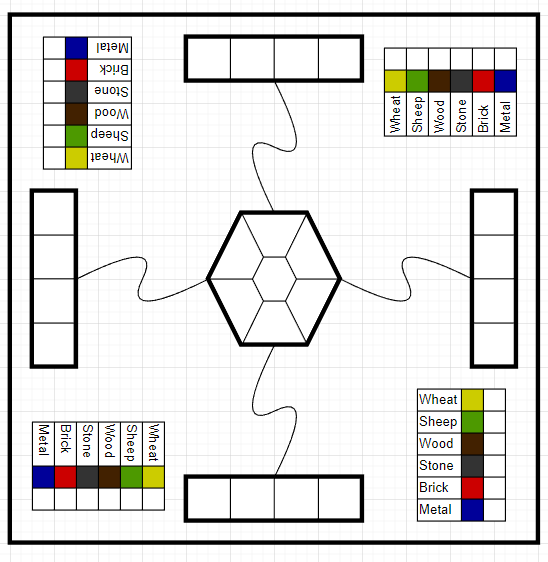
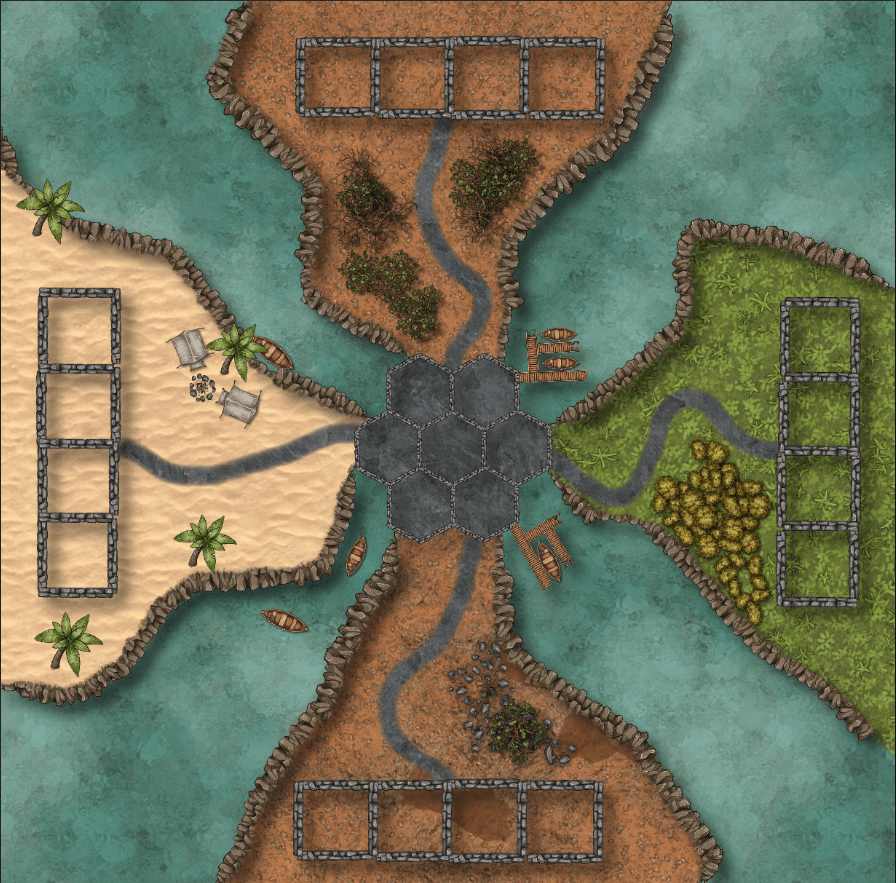
Prototyping
The game takes inspiration from a number of other games, Catan [Mayfair Games 1995], Offworld trading company [Mohawk Games 2016], and Stocks & Shares [Pepys 1957].
Guhe, and Lascarides, (2012) examined how trading worked in Catan, a zero-sum game where there is only one winner with all other players losing. They found that even with this as the end goal, players still had to make alliances and trade to not only further their own needs and goals, but also to prevent other players from winning.
This was something I wanted to incorporate within the design of this prototype.
Initially I considered making a hexagon tile board where you started off with basic recourses and through trade you would gather enough resources to build more advanced buildings.
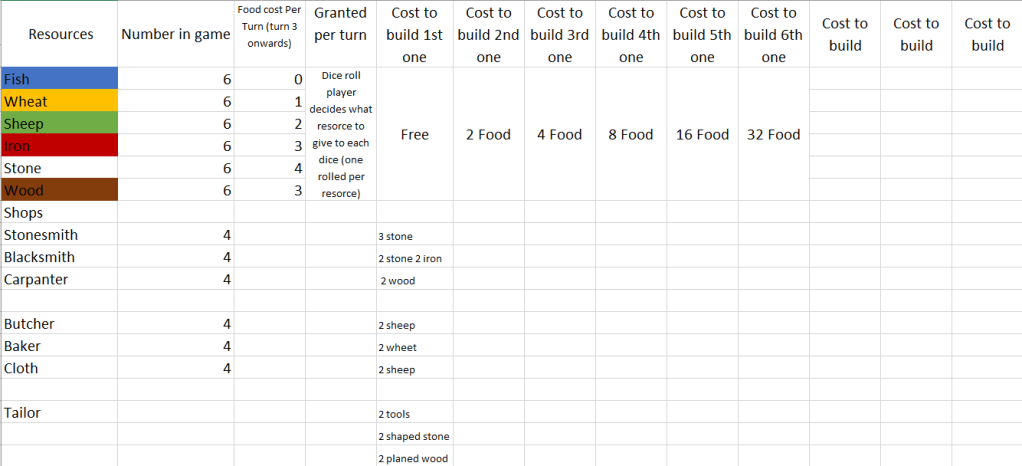
However, it ended up becoming too complicated, with too much time spent trying to work out the basic costs and resource uses. It was missing some basic elements. What was the basic game play loop, how do players win, what encourages them to trade…. there was none. Having to go back to the start gave me perspective, I had rushed into the idea without thinking it through.
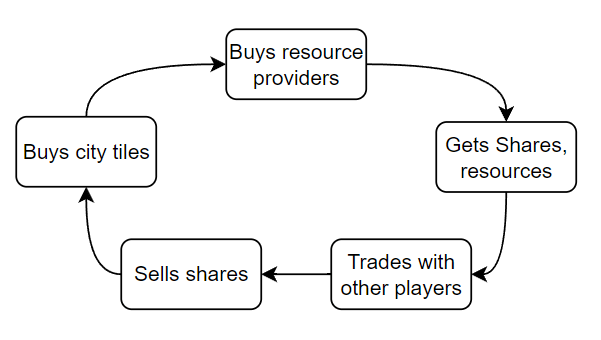
Once I had planned the new concept, I had other students playtest it for me and made a number of changes based on their feedback. One of the biggest areas of feedback was that in this iteration of the game there was no real need for buying extra stock cards as you cannot control what stock you changed the price of, and they were to expensive to buy. This was changed in future iterations. It also gave me insight as to how potential players would trade with others and gamble on buying stock cards. Do you get into a bidding war, how much are you willing to pay to change the price of one resource.
Another change was a quality-of-life change with the addition of the Costs Card. All testers found keeping track of what cost what, as well as the starting costs for trades was a little too much to remember without having to ask.
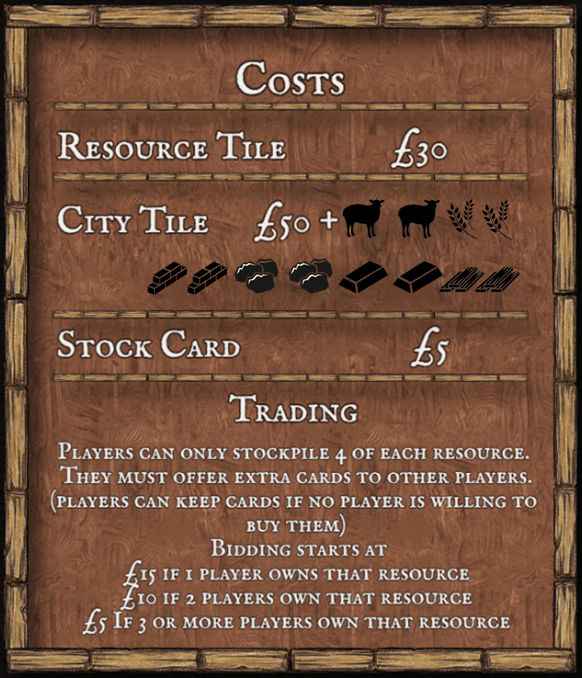
Upon reflection this prototype went well. I believe that it covers the constraint as it requires the players to think and plan what they are going to do based on their and the other players actions. However, I could have spent more time in implementing the basic core gameplay loop rather than rushing into cost, and resource management aspects without having a plan of how the game was going to work.
References
Adobe Inc (2022) Adobe Photoshop [Application] Microsoft Windows.
DRAW.IO. 2022. ‘Flowchart Maker & Online Diagram Software’. app.diagrams.net [online]. Available at: https://app.diagrams.net/.
Dream by WOMBO’. n.d. dream.ai [online]. Available at: https://dream.ai/.
Guhe, M. and Lascarides, A., 2012. Trading in a multiplayer board game: Towards an analysis of non-cooperative dialogue. In Proceedings of the Annual Meeting of the Cognitive Science Society (Vol. 34, No. 34).
Inkarnate – Create Fantasy Maps Online’. n.d. inkarnate.com [online]. Available at: https://inkarnate.com.
Mayfair Games. (1995) Catan [Board Game] Physical.
Microsoft Corporation (2022) Microsoft Publisher [Application] Microsoft Windows.
Mohawk Games (2016) Offworld trading company [Video Game] Microsoft Windows, macOS, Classic Mac OS.
Pepys (1957) Stocks & Shares [Board Game] Physical.
 deannamarshall.co.uk