The Reflective Blog
Over the past six weeks I have been posting one blog a week reflecting on one thing that I have been doing over the past week. Now to be clear I find this very hard, I struggle to analyse and reflect on things I have done. However, I realize this is important as self-reflection helps me grow as a developer. Farrand et al (2010) conducted a study that showed that using a reflective blog helped the participants in the self-reflective process, as well as improving communication with in the focus group.
Even though I only had to do six posts I plan to continue with this throughout the rest of the masters course.
The Blogs
I had to do reflective blogs in the first two years of my undergraduate course, and I hated it, I did not think they were important or useful. A good example of this is below, it is basically just a narrative of what I did that week, there is no attempt to critically examine anything.
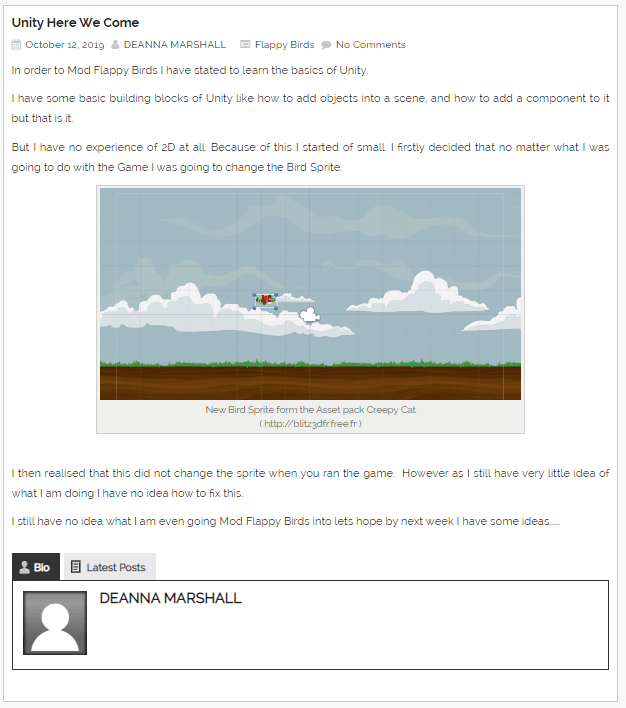
(https://journal.falmouth.ac.uk/dm229110/2019/10/12/unity-here-we-come/)
However, having restarted doing them for the master’s has allowed me to revaluate this perspective and take a critical look into them. I have found that examining elements of my week through a blog allows me to consider how I approach things if I was doing the same thing again, (would I change anything or do the task the same way again) how I could improve on what I did, or even just allowing me to plan and organize better.
As Grant et al. (2002) notes.
Purposeful progress through the cycle of self-regulation towards a specific goal rests on an individual’s being able to monitor and evaluate his/her progress and use such feedback to improve his/her performance.
Looking back at the example above I could have investigated what rescores were available that would have provided me more insight into 2D within Unity a good example here would have been Developing 2D Games with Unity by Halpern (2019), or Unity 2D game development by Calabrese (2014).
I also could have spent some time exploring what I was going to do throughout the project and how so set goals. A quick google search of “setting goals for a project” would have introduced me to SMART goals. I then could have made use of this.
References
Calabrese, D., 2014. Unity 2D game development. Packt publishing.
Farrand, P., Perry, J. and Linsley, S., 2010. Enhancing self-practice/self-reflection (SP/SR) approach to cognitive behavior training through the use of reflective blogs. Behavioural and Cognitive Psychotherapy, 38(4), pp.473-477.
Grant, A.M., Franklin, J. and Langford, P., 2002. The self-reflection and insight scale: A new measure of private self-consciousness. Social Behavior and Personality: an international journal, 30(8), pp.821-835.
Halpern, J. and Halpern, 2019. Developing 2D Games with Unity. New York City: Apress.
 deannamarshall.co.uk